



Growing up in Fremont, Wyatt Spalding and his twin brother, Wes, could nearly always be found playing basketball in the driveway. From ball-handling drills to 1-on-1 matchups, the brothers were bonded by the game.
At age 9, Spalding remembers Wes telling him, "I'm not going to let you win anymore."
Spalding drove toward the basket for a layup when his brother blocked the shot, sending the ball into the street. Spalding realized that he was different from Wes.
Despite years of health challenges and watching doors close because of his cerebral palsy, Spalding's passion for sports never faded. If anything, each setback deepened his love of the game.
"When you're denied something, they tell you you can't do it, then you kind of just want it more," Spalding said.
The Spalding brothers kept battling on the court, adapting to the situation and creating new rules to keep the playing field even. Wes would wear ankle weights or Spalding would start the game with a 15-point lead.
"I always hated that people thought because I have a disability, we couldn't do what brothers usually do," Spalding said. "We didn't let that really stop us."
In fifth grade, his dad sat him down and told him he couldn't play on the same team as his brother, Wes, anymore because it was too dangerous.
Special Olympics gave him hope.
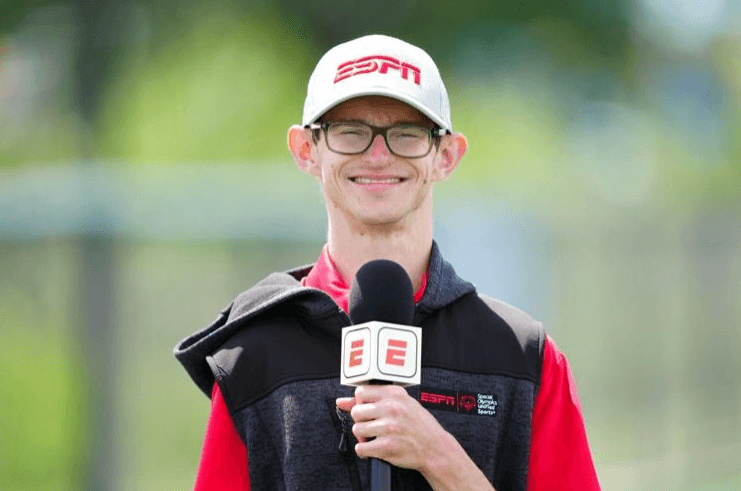
Wyatt Spalding's experience with podcasting and public speaking helped prepare him for his gig on ESPN, commentating for the Special Olympics.
Since joining Special Olympics, Spalding has become a national gold medalist in tennis, competed at the Special Olympics USA Games for unified basketball and now works for Special Olympics Nebraska as a program associate. He travels the world to speak about his experience and promoting inclusion as a Sargent Shriver Global Messenger for Special Olympics.
At the end of June, Spalding fulfilled his dream of working in the sports industry when he served as an ESPN contributing broadcaster at Special Olympics USA Games.
A dream come true
The Special Olympics USA Games ran through June 20-26 in Minneapolis and featured more than 3,000 athletes across 16 individual and team sports from all 50 states.
Spalding co-hosted the opening ceremony alongside ESPN's Jen Lada and Kevin Conners.
"My job was to feed off of what Jen and Kevin were saying during the opening ceremonies," Spalding said.
Spalding's experience with podcasting and public speaking for Special Olympics prepared him for the off-the-cuff, unscripted analysis required by his role with ESPN.
For Special Olympics Nebraska, Spalding runs a podcast called "Brave in the Attempt" that explores stories of perseverance from the organization's athletes, coaches and volunteers.
"Special Olympics prepared me for this moment of working at ESPN, even if they don't know it," Spalding said.
Outside of his assigned interviews with players and teams, Spalding was able to pitch ideas to the crew and explore his own storylines throughout the tournament.
Thinking about his own experience competing at the USA games in 2018 and 2022, Spalding remembered the role his parents and siblings played in helping him get to the national stage and sought to find similar stories for ESPN.
"I came up with an idea to interview the family members because they're a big part of how the athletes get there," Spalding said. "There's this group of people that are always there at events cheering them on."
Wyatt Spalding, a Lincoln resident and Shriver Global Messenger for Special Olympics, center, had the opportunity to be a commentator for ESPN at the 2026 Special Olympics USA Games in Minneapolis last month. Spalding worked with ESPN's Jen Lada, left and Kevin Conners, right.
Spalding qualified for the Special Olympics USA Games twice: in 2018 for doubles tennis and in 2022 for unified basketball. Before both of the tournaments, Spalding went through medical setbacks that put his ability to compete in doubt.
His stomach shut down two months before the 2018 games in Seattle. He couldn't eat or drink anything without gasping for air, losing 10 pounds in two days. Spalding recovered in time to compete, fighting through the pain the entire tournament to win a gold medal in mixed doubles with his partner, Haley Waggoner, and a bronze medal in singles tennis.
Ahead of the 2022 games in Orlando, Florida, Spalding got pneumonia. Instead of flying, his parents, Mary Jo and Rick, drove him in their RV so he could compete with Wes in unified basketball. The team placed fourth in the top division.
During his interviews, Spalding sought to highlight the people who helped athletes reach the Games, just as his parents had done for him. A highlight show of Spalding's segments will be airing on July 25 at 11 p.m. on ESPN.
Spalding said he learned a lot from his broadcasting debut and the opportunity to shadow some of the industry's best during his week with ESPN. He was even interviewed for a feature in The Players' Tribune.
"It was a dream come true because I always wanted to work in sports," Spalding said.
Born a competitor
After a lifetime of loving sports, the opportunity to work for the biggest name in American sports media seemed like the opportunity of a lifetime. But for Spalding, the accomplishment means nothing without the process.
Spalding's journey to becoming an ESPN contributor has been far from linear.
As a twin, Spalding was born prematurely. In the NICU, Spalding battled several medical issues and underwent 13 surgical procedures within the first seven months of his life.
"The nurses were always talking about how he was the smallest baby in there, but he's got the loudest cry," Mary Jo Spalding said. "I think he was just born with that fight to live. It's just in his DNA."
During his senior year of high school, Spalding's back had an 80-degree curvature that threatened to crush one of his lungs. Spalding wasn't scared of the extensive risks that accompanied the back fusion surgery that would fix the curve. He was more afraid of spending the rest of his life with his body slowly crushing his organs if he chose to do nothing.
If he could survive the countless nights where doctors had to do CPR to keep him alive all before he even reached the age of one, Spalding could survive this surgery.
Spalding spent months in St. Louis recovering from the surgery, missing almost his entire senior year.
Wyatt Spalding competed in the Special Olympics in 2018 and 2022 and helped with ESPN's broadcast for the 2026 games last month.
After the surgery, he had to relearn to walk. He had spent his entire life moving, but now he was confined to a hospital bed. The recovery took a toll on more than his body as he fell into a depression.
Spalding's goal for high school had been to compete at the Special Olympics USA Games. Due to the surgery, he missed out on the 2014 games. Refusing to give up, Spalding found a new motivation to carry him through his recovery.
"I just had to figure out how I was going to get to the USA games if I wanted to. Mentally, it was hard," Spalding said.
After his surgery and graduating from Fremont High School, Spalding went to Midland University.
"We just wanted you to have the college experience and just have the experience of living in a dorm, but we knew that you had to be close to us," Mary Jo said.
Although it wasn't exactly what he had imagined, college gave him his first hint of an independent life. Amid his search to figure out what he was going to do with his life, he left college.
Spalding struggled to find a job because of his disability, and he was desperate to move out of his parents' place in Fremont.
"He'd go to interviews, but people wouldn't hire him," Mary Jo said. "And so we thought, what if he could be his own boss?"
Mary Jo said that Spalding had always been good at conversation, so with his passion for sports, they suggested he start a podcast.
In 2021, Spalding began his first podcast, "Be Unexpected," with his friend, Jake Burnside. The show shared the stories of people who had faced adversity through their lives and how they found their way through hardship.
Guided by his competitive spirit and unwavering work ethic, Spalding was determined to make the most of his situation in life.
At age 29, Spalding finally moved out of his parents' place.
"My medical conditions are always going to be in the way, but I'm going to figure it out," Spalding said. "I really just wanted to prove that I could pay my own bills and that I could have my own place — that I could follow my own path."
Spalding said his parents taught him that, while he has faced a tremendous amount of hardship due to his disability, he is not the only one whose life has been hard. With that mentality, Spalding has found a passion for telling people's stories, especially those who have been through difficult times.
After his week with ESPN, Spalding hopes to continue broadcasting and working toward a career in sports.
Through every high and every low, Spalding has had Wes by his side.
"Basketball helped us both get through it," Spalding said.
